(This is the final essay in our series on the role of Gaian Psychology in solutions to the Metacrisis curated by Zhiwa Woodbury. This piece is a personal reflection by Professor Sean Kelly on the life, death, and post-tragic ecological message of Joanna Macy.)
------------------------------------------------------------------------------
IT'S BEEN HALF A YEAR since the passing of a great Shambhala warrior. Despite the deep sense of loss, in some ways, she is more present to me than ever.
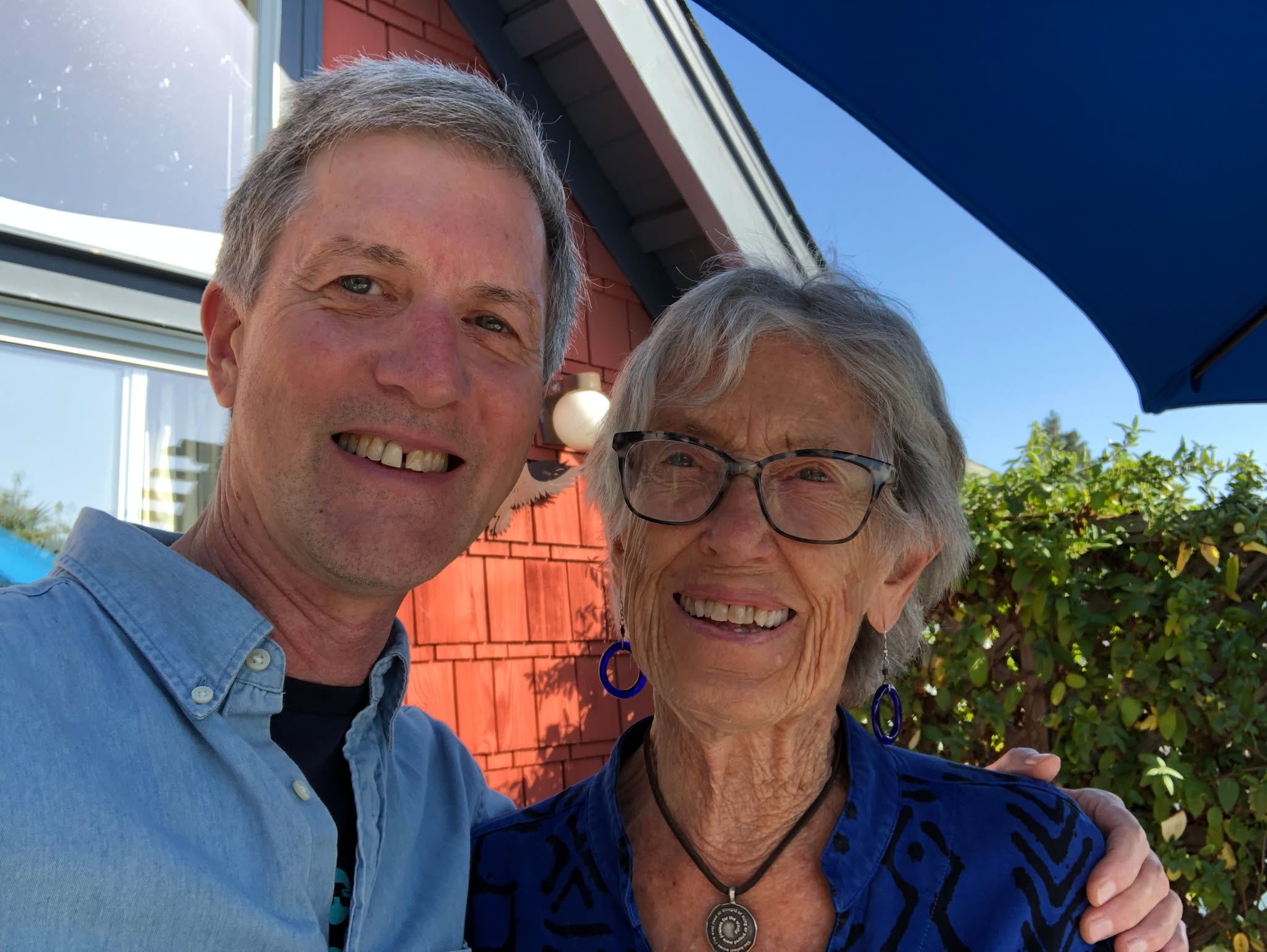
I first met Joanna Macy at the turn of the new millennium. It was the post 9/11 world with the so-called War on Terror and the devastation of Iraq. I invited her to offer an intensive course in the Philosophy, Cosmology, and Consciousness program that I’ve been teaching in for the past three decades. I attended the course, and like anyone who’s had the privilege of meeting Joanna in the flesh, I was immediately struck by her intense vitality and the radiance of her presence. She would’ve been in her early 70s then. The course had a profound and lasting effect on me. The combination of her teachings and her facilitation of the experiential exercises she had developed – originally called “Despair and Empowerment,” then “Deep Ecology Work,” and eventually, “The Work that Reconnects” – was particularly powerful and uniquely suited to our times, both then and now. Through such exercises as “Widening Circles” and “The Council of All Beings,” the Work helped catalyze what Joanna calls the moral imagination and allowed for a direct experience of what I knew intellectually to be true – namely, that we are interdependent expressions of Gaia, living members of the living Earth. It also helped me become more conscious of my pain for the world, honoring it through its expression, and so also taking a step in the direction of its healing.
Not long after that course, I wrote a long monograph on the nature of time and the soul (Kelly, 2008). Given the role of “deep time” in Joanna’s teachings, with the corresponding practices that raise to awareness our relationship to the ancestors and the future beings, and especially after hearing her speak about the esoteric Buddhist notion of the “fourth time,” I sent her a copy of my monograph. A couple of weeks later I received an email from her with the subject heading, “brilliant idea!” In the text of the email, to my surprise and great delight, she proposed that we offer a course together with a focus on the nature of time. Though with some trepidation, I of course immediately agreed. The following academic year we offered the course, “The Great Turning: The Fullness of Time.” Over the next decade and a half, we co-taught the Great Turning course another four times, once with the subtitle “Light and Shadow.” After she decided to retire from teaching, she gave me her blessings to offer the course on my own, which I have been doing ever since.
Joanna and I saw eye to eye, or heart-mind to heart-mind, on every topic of any significance, especially those touching upon the political economy and fundamental ethics. No doubt the overlap in our religious and intellectual formation had something to do with this. Though my family of origin was Catholic and hers Baptist, and while neither of us was any longer affiliated with any church, the core ethical teachings and root symbols of the Christian tradition had structured the foundations of our world views. We also shared a long-standing engagement with the Buddha Dharma, systems thinking, and more integral and enchanted versions of the new cosmology, as well as a love of literature and other languages. Further, we both drew from of the insights of Jungian psychology. I’m sure there were other more inscrutable, and likely karmic, factors as well, given how quickly and inextricably Joanna and her life’s work was woven into the fabric of my own life and work.
***
In terms of her teachings, everything centers around the concept – and in Jungian terms, the living symbol – of the Great Turning. The most immediately apparent virtue of this concept is that it allows for a reimagining of the idea of activism. Along with holding actions, which is what is normally understood by activism, Joanna recognized two other dimensions: alternative structures (including such things as green energy, communitarian modes of living, regenerative agriculture, and many other practices in harmony with the ways of Gaia); and a fundamental shift in consciousness. This shift is centered around recognition of our essential interbeing with Gaia and the entire Earth community (as explored in this series on Gaian psychology and the Psychospheric worldview ) as well as with the cosmos at large.
The Great Turning is much more than a theory or a set of practices, however. It is a living symbol, as indicated above, in that it can facilitate generative communication between surface levels of consciousness and the deeper archetypal ground upon which that surface rests. The archetype in question is that of Life itself, or we could also speak in terms of the death/rebirth archetype. The virtue of this archetype is that it answers to the unique character of our moment in the evolution of the Earth community. There are many ways of characterizing this moment. On the one hand, it is a time of Great Dying, poised as we are on the threshold of something which no human has ever witnessed before: the Sixth Mass Extinction of Species, with its attendant dramatic declines in terrestrial wildlife (85%) and large marine species (90%). At the same time, we are currently witness to a culmination of the process of what Teilhard de Chardin called planetization, which began half a millennium ago with the birth of the modern period, or Planetary Era as I like to call it (Kelly, 2010).
The living symbol of the Great Turning is resonant with other names proposed to mark the unique character of our age. The closest parallel, though lacking the same archetypal power, is the idea of “The Great Transition.” Other more symbolically or psychospiritually potent terms include Swimme and Berry’s “Ecozoic Age” and Jean Gebser’s “Integral Age.” There is also the idea of a second Axial Age, first proposed by Thomas Berry and elaborated upon by his colleague, Ewert Cousins. The first Axial Age – centered around the 6th to 4th centuries, BCE, but functionally including the birth of Christianity as well – saw the birth of the first world religions and philosophical traditions. The latter, however, were mutually exclusive and emphasized transcendence. The second Axial Age unfolding in our times, by contrast, though in my understanding organically continuous with the first Axial Age, transcends the first by being truly planetary and Gaia-centric in nature (see Kelly. 2021).
By whatever name, however, the new age that is upon us echoes the mythic image of a “new Heaven and new Earth” announced in the last book of the Bible. And true to the title of that last book – Apocalypse or Revelation – the new age is increasingly apocalyptic, in two senses. Most obviously, there is the prospect of worldwide devastation through the mutually reinforcing processes of global heating, mass extinction, and civilizational collapse. Paradoxically, but true as well to the etymology of the word “apocalypse,” the new age is also one where the veil has been lifted, and the fundamental truth of interbeing and the revelation of our common cosmic and Gaian origins and destiny is obvious for those with eyes to see. Tragically, however, there are still many who do not see, blinded as they are by the three poisons of hatred, greed, and delusion.
The same paradox is expressed in Joanna’s re-telling of the Shambhala warrior prophecy. “There comes a time,” Joanna tells us
“when all life on Earth is in danger. At that time great powers have arisen, barbarian powers, and although they waste their wealth in preparations to annihilate each other, they have much in common. Among the things these barbarians have in common are weapons of unfathomable devastation and death and technologies that lay waste to the world. And it is just at this point in our history, when the future of all beings seems to hang by the frailest of threads, that the kingdom of Shambhala emerges. You can’t go there because it is not a place. It exists in the hearts and minds of the Shambhala warriors…." (Macy, 2021, p. 210)
The “weapons” of the Shambhala warriors, the only antidotes to the three poisons, are the twin instruments of wisdom and compassion—the insight of interbeing (which includes seeing the entire Earth community, human and non-human, as kin) and a radical opening of the heart-mind to the true nature of suffering.
Joanna recounts how, in her first excited retelling of the prophecy after receiving it from Dugu Choegyal Rinpoche, her son Jack, asked: “But Mom, didn’t he tell you how it was going to turn out?”(ibid., p. 212). Unlike the biblical Apocalypse, however, this is not that kind of prophecy. There is no end to the story, at least not in linear time. Instead, there is a radical opening, or left-openness, in the form of an invitation or calling to enter here and now into the kingdom of Shambala.
When Joanna and I first offered the Great Turning course together, the idea of the Great Turning was presented as the third of three concurrent narratives or stories characteristic of our times. The first and still dominant one is that of Business as Usual, focused on Money and Power. The second, which has begun to receive more attention, is that of the Great Unraveling. Initially, the latter was primarily the story of ecological devastation. Increasingly, however, it came to include the likelihood of civilizational collapse as well.
In the earlier phase of Joanna’s teaching, and including the first time we offered the course together, the Great Turning was presented as the desired alternative to the Great Unraveling. As bad as the situation seemed, it was still possible for many – myself included – to believe in a fighting chance to halt and possibly reverse the Great Unraveling. By the second time we offered the course, however, and increasingly thereafter, I found myself less and less capable of such belief. When, for instance, I allowed the future beings to speak through me in the reconnecting practice called “The Seventh Generation,” they spoke from a time and place of such loss and devastation that hardly seemed compatible with my earlier understanding of the Great Turning. While we both still appealed to the truth of radical uncertainty, to the hidden potential of complex systems for unanticipated creative emergence, this truth was losing its potency as a counter to and brutal reality of the Great Unraveling.
It was about this time that Joanna and Chris Johnstone began work on and then eventually published their book, Active Hope. I was somewhat surprised by this highlighting of hope, given its lack of emphasis in the Buddha Dharma (and this in stark contrast to the role of hope in traditional Christianity) and what I took to be Joanna’s corresponding emphasis on the liberatory potential of the here and now. It’s true that, in the way that they defined it, active hope does not involve belief in some kind of “happy ending.” It is “something we do rather than have,” they write.
The guiding impetus is intention; we choose what we aim to bring about, act for, or express. Rather than weighing our chances and proceeding only when we feel hopeful, we focus on our intention and let it be our guide (Macy and Johnstone, pp. 4-5).
I appreciate and can affirm such a practice, even if I personally have chosen to work with the idea of (a new kind of) faith rather than hope (Kelly, 2021). Zhiwa Woodbury has addressed this ‘hope vs. faith’ issue from the perspective of Gaian Psychology:
[B]ecause we live in an age where faith is mostly absent, people are forced to speak of hope as a proxy for faith. By abandoning unrealistic hope, they implicitly lose faith as well, throwing the baby out with the bathwater. But remember, for most of human history, it is faith that has sustained us, not hope. (Woodbury)
***
In any case, in the years following the publication of Active Hope, the planetary polycrisis (Morin and Kern, 1999), or what many now also refer to as the metacrisis, only continued to accelerate. In 2018, I introduced Joanna to Jem Bendell and his work on deep adaptation (Bendell, 2021). Following an extensive review of all available evidence, Jem had come to the conclusion that societal or civilizational collapse is inevitable, is in fact already unfolding, that ecological catastrophe is now quite likely, and human extinction not as unlikely as we like to think. Jem’s work, along with that of French collapsologists Pablo Servigne and Raphaël Stevens (2020) encouraged Joanna and me to reimagine the relationship between the Great Turning and the Great Unraveling.
Rather than facing a fork in the evolutionary road, we both came to see that the Great Turning was occurring through and despite the Great Unraveling:
The Great Turning is not an alternative to collapse, but a passage through. As an evolving vision and commitment, it shapes and ripens us as we make our way through the rubble of industrial growth society. This passage can be seen as a kind of planetary initiation, a collective rite of passage to the possibility, at least, of a human culture in harmony with a greater life of Gaia, and through whom we have our being. (Kelly and Macy 2021, p. 207)
This does not mean that we should not do everything in our power to slow or counter the Great Unraveling, or merely adapt to it in the usual understanding of that word. Rather, from the perspective of deep adaptation one should remain committed to all available regenerative practices and pathways. But critically, as is the case with “active” hope, one is not attached to outcome. One certainly does not condition their choices and actions on some vague guarantee, or even likelihood, of avoiding further collapse and catastrophe, which quite often leads to burnout and hopelessness : “Rather than trying to sustain activism through the expectation of a successful transition to a life-sustaining society or ‘ecological civilization,’ active hope involves an affirmation of the liberating power of intention and choice in the present and in the near term of what is always possible to achieve: a life guided by wisdom, compassion, and generosity.” (206) As Joanna wrote in the 30th anniversary edition of World as Lover, World as Self:
Liberated from the need for certainty – and even hope – we can more fully inhabit the present moment. Not knowing rivets our attention on what is happening right now. This present moment is the only time we can act, and the only time, after all, we can wake up. (p. 212)
The same holds for my own proposal for a different kind of faith: “Not a faith in otherworldly salvation, or in the promise of endless ‘progress,’ but faith as a trusting in, and unconditional affirmation of, our mutual solidarity and common destiny as earthly or Gaian beings.” (207)
As with the timing of the appearance of the Kingdom of Shambhala, there is a paradoxical or complex character to the ground of this kind of faith. On the one hand, in line with the core teachings of “original enlightenment” (hongaku)—often summed up in the phrase, 草木山河悉皆成仏 (Sōmoku sanka shikkai jōbutsu) [the grasses, trees, mountains and rivers all attain Buddhahood], we can rest in the affirmation that Gaia, the living Earth, is already in itself the “Pure Land” (see Stone).
At the same time, however, the truly open heart-mind is no stranger to pain for the world. It suffers with (com-passion) the world and is thereby moved to alleviate this suffering. Joanna summarized this new understanding of the Great Turning in the concluding paragraphs to the revised edition of World as Lover, World as Self:
We find our dignity and purpose in the Great Turning, as scales fall from our eyes and we see that transforming Nature into money doesn’t work. We discover that a deep ecological vision can bring us through with all that we are and can become. We are cleansed by the truth of belonging to Earth. And in this very act we allow ourselves to recognize that we may not be able to avoid the collapse of our planet as a home for life that has evolved over millions of years. In either case, we move forth as a human family, as a planet people bearing the gifts and injuries of our Ancestors, right along with all other life forms on this planet. (217)
***
Now Joanna is one of the Ancestors. The Joanna I knew and loved has passed over, as everything that exists must pass. And yet, she abides. By this I don’t merely mean a persistence in memory, though there is that too, and poignantly so. Rather, once again, there is a paradoxical presence/absence, or better, a new kind of presence that is not mediated by the normal senses. I realize that many will baulk at this, as Joanna herself might have done on occasion when, for instance, I questioned her about her relationship to her husband, Fran, after his passing. At first, there appeared only to be her painful awareness of his absence, which I took to be a normal response, the inevitable mourning of the departed beloved.
I wasn’t able to determine the details of her experience then, but in later years Joanna would speak of Fran in a way that suggested she had gained a new sense of his presence. I remember sharing with her what I had been trying to cultivate at the suggestion of Rudolf Steiner, whose recommendations regarding how to stay connected with the “so-called dead” I found compelling (Steiner). According to Steiner, since the departed no longer have bodies, they clearly cannot be seen with the physical eyes (though there is substantial evidence of the departed appearing to close relative at the time of death or shortly thereafter) (see, e.g.: Meyers and Gurney et al.). What is required instead is learning how to feel being seen by them, which in my experience requires a certain degree of trust.
In doing so, one might also continue to “see” the departed in the mind’s eye. In my case, especially in the couple of weeks immediately after her passing, I began seeing Joanna as she appeared throughout the course of her entire life, rather than as I had known her over the past couple of decades. It was almost as though I was participating in her own life review which, as we know from reports of NDEs, is a common experience of people on the threshold of death. Beside my own personal memories of her, there were scenes of Joanna racing down ski slopes; behind a pulpit delivering her first fiery sermons on the social gospel; with Fran and daughter Peggy smuggling themselves into Tibet through a mountain gorge with the Milky Way as their guide; Joanna fingering her first copy of Rilke’s poetry that she had just found at a bookstall in Germany; Joanna sitting quietly in the back cottage on Cherry Street in meditation on the Yamantaka and the “poison fire”—all of these moments still living in a more compendious present. Since then, having passed through the initial period of mourning, and though the images and memories persist, I am gradually gaining a more stable sense of Joanna’s continued, if subtler, presence in my life and in the world.
***
In the last couple of years before her passing, as the precious human body became more and more frail, Joanna’s attention retreating more and more to the immediate present, it was striking to witness the undiminished flame of her passion for life. While she could no longer maintain her former practice of tracking the latest political developments or the complexities of the polycrisis, she was as curious as ever about the world around her, and especially about whomever she happened to be with. It was as though she had settled into the first station in the spiral of the Work – Coming from Gratitude – and it was enough, more than enough, for her to savor her embeddedness in the web of life and the community of family and friends that surrounded her, a community which she had done so much to shape and catalyze. Now that she is an Ancestor, one whose sense of presence I am cultivating, I ask myself: Just who is this Joanna?
Here it might be helpful to make a distinction between the personality and what is usually called the soul, or what Sri Aurobindo calls the psychic being (Aurobindo, pp. 56-61). To take a concrete example, we can make the distinction between His Holiness the Dalai Lama – or more specifically, Tenzin Gyatso – on the one hand, and the Bodhisattva Avalokiteśvara, on the other, one of whose emanations or (re)incarnations His Holiness is believed to be. I can well imagine that Joanna being another such emanation, though Mañjuśrī, the Bodhisattva of Wisdom, would be equally plausible, particularly in his fierce manifestation as Acalanātha (or Fudō Myōō in Japanese: the “Immovable Radiant King”).
Whatever the true name of Joanna’s soul nature, I imagine it as including, even as it transcends, the person I came to know and love as Joanna. And how could it not, given how she loved to see herself, and how she taught others to see themselves? As not-other than the world, and to see the world as lover. And so, along with learning to be seen by her, I am delighting in those moments that I can behold her in the world, while at the same time lending her my eyes to behold and love the world anew. The precious human body that is no more can in this way be seen in, as, and through the larger body of Gaia and “all her relations” of care, common interest, and love, the very same relations that once nourished her and now nourish Gaia.
For this too, I am grateful.
And so I am honored to close this series on Gaian Psychology with a toast I composed on the occasion of Joanna’s 91st birthday and the publication of the revised edition of A Wild Love for the World (2020):
Our Lady of the Bestiary
devoted daughter of wide-bosomed Gaia
shield-maiden of the Yamantaka
and guardian of the poison fire
Truth-speaker
Justice-seeker
friend of the poor
and the forgotten
Kindler of a wild love
for the world
for all things beautiful
and true, and good
Bodhisattva warrior
bard of interbeing
Scholar, teacher, poet, leader
mentor, colleague, friend
lover, always a lover
beloved, forever beloved…
Berkeley, January 18, 2026
-------------------------------------------------------------------------------------
References
Aurobindo, The Integral Yoga: Sri Aurobindo’s Teaching Method of Practice. (Selected Letters of Sri Aurobindo). Sri Aurobindo Ashram, 1993.
A Wild Love for the World: Joanna Macy and the Work of Our Time. Edited by Stephanie Kaza. Shambhala, 2020.
Bendell, Jem. “Deep Adaptation: A Map for Navigating Climate tragedy.” In Deep Adaptation: Navigating the Realities of Climate Chaos. Edited by Jem Bendell and Rupert Read. Polity Press, 2021.
Gurney, Edmund, and Frederic Myers and Frank Podmore. Phantasms of the Living. Volumes I and II. Obscure Press. 2019 (1886).
Kelly, Sean. “Integral Time and the Varieties of Post-Mortem Survival.” In Integral Review, June 2008 x Vol. 4, No. 1, pp. 5-30.
Kelly, Sean, and Joanna Macy. “The Great Turning: Reconnecting Through Collapse.” In Deep Adaptation: Navigating the Realities of Climate Chaos. Edited by Jem Bendell and Rupert Read. Polity Press, 2021.
Kelly, Sean. Becoming Gaia: On the Threshold of Planetary Initiation. Integral Imprint, 2021.
Macy, Joanna. World as Lover, World as Self. 30th Anniversary Edition. Parallax Press, 2021.
Macy, Joanna, and Chris Johnstone. Active Hope: How to Face the Mess We’re in with Unexpected Resilience and Creative Power. New World Library, 2022.
Meyers, Frederick. Human Personality and Its Survival of Bodily Death. Volumes I and II. Forgotten Books, 2018 (1900).
Servigne, Pablo, and Raphaël Stevens. How Everything Can Collapse. Polity, 2020.
Steiner, Rudolf. Staying Connected: How to Continue Your Relationships with Those Who Have Died. Steiner Books, 1999.
Stone, Jacqueline. Original Enlightenment and the Transformation of Medieval Japanese Buddhism. University of Hawai’i Press, 1999.
Woodbury, Zhiwa. Planetary Hospice.